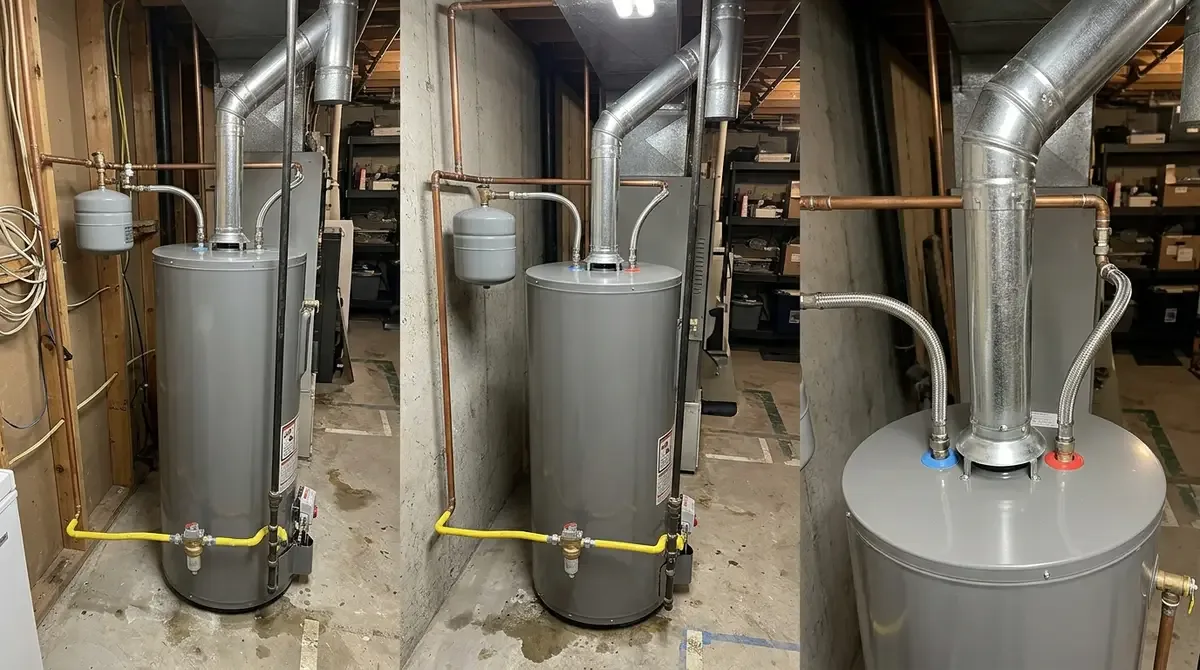
Water heater replacement in Parker, CO
One visit: the old tank out, a new one matched to your household in, and the permit handled.
Job price
$2,450
We remove your old tank water heater and install a new one sized for your home, fully connected and tested, with the old unit hauled away before we leave, here in Parker, CO. You get a working, right-sized system replaced in a single visit, not a multi-day project.
How replacement works
What actually wears out in a tank
A tank water heater usually lasts eight to twelve years, and the signs it's failing are pretty consistent: hot water that runs out faster than it used to, water pooling at the base, or rusty color in the hot tap.
Once a tank starts leaking it's not a repair job, it needs to be replaced before it does more damage to the floor around it.
We size the new tank to your household, not just a same-for-same swap, since a house that's added people or a second bathroom since the last tank often needs a bigger one.
Inside an ageing tank, sediment settles out of the water and builds up across the bottom, which is why an older heater takes longer to recover and can rumble or pop while the burner runs. The anode rod is meant to corrode in place of the steel shell, and once that rod is spent the shell is next in line. Neither one is worth chasing on a heater that has already passed its decade, so the honest conversation at that point is about a new unit rather than parts.
A replacement is rarely only a tank. Codes have moved on since most existing heaters went in, so a drain pan under the unit, a correctly sized expansion tank on the cold line, sound gas or electrical connections and a vent that draws properly are the pieces that turn a bare swap into a finished, inspectable installation. Those are the parts of the day that take the time, and they are the reason we look at the room before anyone puts a figure on the work.
Typical lifespan
8–12 years The window most tank heaters run before signs of failure show up.What you get
What's included in the job?
- Draining and removing the old heater
- A new tank sized to your household
- New connections, valves and a pan where needed
- The permit and the haul-away
When should you call?
Signs it's time to replace, not repair
- No hot water or it runs out fast
- Water pooling around the base of the tank
- Rusty or discolored hot water
- The tank is more than ten years old
On the day
What happens on the visit
Every replacement runs the same four steps in the same order, so you always know where the visit has got to. All we ask of you is a clear path to the heater and pets kept out of the utility room while the water is off; the rest of the day is ours.
- 01
We check the old heater and the space it sits in
- 02
We price the replacement before we start
- 03
We swap the heater the same day
- 04
We test it and haul the old one away
Questions before you book?
Talk to a plumber Not sure yet whether it is worth replacing? Describe what the heater is doing and how old it is and we will tell you straight whether it sounds like a swap or a repair.One number
One job, one price
The figure printed in the panel at the top of this page is the job, not a starting point that grows once a van is in the driveway. It carries the labor, the new unit and the four items on the list above, and it is the only number attached to this service.
A swap is one piece of work, so we quote it as one piece of work. Hourly rates and open parts lists make two quotes impossible to compare; a single number does not. You hear that number standing in your own utility room, after we have looked at the heater and the space around it, and the work starts from there.
Before you book
What affects the price?
Two houses on the same street can land on different numbers. It is almost always the tank itself or the room it stands in that moves the figure, and both are things we can read in a couple of minutes.
- Tank size is the main factor: a larger tank costs more than a standard 40 or 50 gallon unit. A household that has grown since the last heater went in usually steps up a size, and that step shows in the total.
- Venting changes, code updates like a new pan or expansion tank, and tight access to the existing heater can all add time and cost. A heater wedged behind a furnace, at the top of a stair run or in a closet with a narrow door takes longer to clear before the new unit can go in.
- We price the job after seeing the space, not off the tank size alone. Photos sent over the phone help us come prepared, but the number we stand behind is the one given in front of your heater.
- Fuel type shapes the work as well: a gas unit brings the vent and the gas connection into the day, an electric one brings the circuit and the breaker, and which you have is already decided by the house.
Common questions
What owners ask us first
How long will I be without hot water?
Most swaps are done the same day, and the new tank heats within about an hour of finishing.
Do you handle the permit?
Yes, the permit is included and we coordinate the inspection.
What size tank do I need?
It depends on your household size and how many bathrooms run at once. We size it during the visit rather than guessing over the phone.
Serving your area
Hours, service area and contact
We serve Parker, Castle Rock, Lone Tree and Highlands Ranch.
Reach us
Other services
Other jobs we handle
Ready for a new tank?
Call and we'll get you on the schedule. Have the age of the heater and a rough idea of how many people it serves to hand, and we'll turn up ready for the work.
Booking is by phone, Monday through Saturday.